
When an Australian business grows, its workforce often has to grow with it. That can create pressure when local recruitment takes time, internal teams are already stretched, or the business needs specialist capability without immediately expanding its local headcount.
Offshore staffing offers another way to build capacity.
Under this model, a company can recruit skilled professionals in another country who work remotely as part of the wider business. These team members may support accounting, administration, engineering, IT, eCommerce, customer operations, logistics, marketing and other functions.
The key idea is that the business is not simply sending isolated tasks outside the organisation. It is building a team that can become part of its ongoing operations.
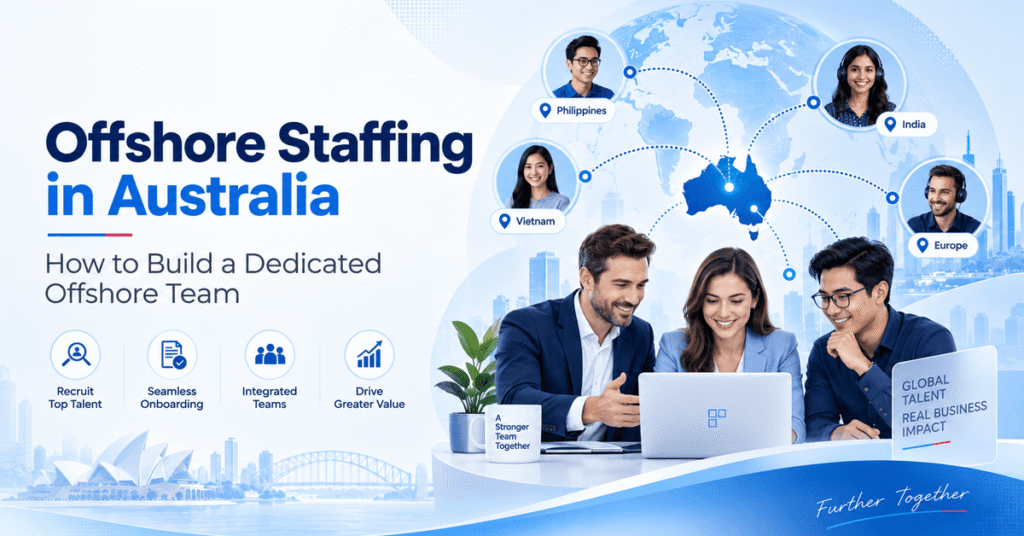
This guide explains the model, the difference between offshore staffing and traditional outsourcing, and the main steps Australian companies should consider when creating a dedicated offshore team.
Understanding Offshore Staffing
Offshore staffing is a workforce arrangement where a business employs professionals who are located in another country but work remotely within the organisation’s structure.
These professionals are typically recruited for defined roles rather than one-off freelance assignments. They may report to managers in Australia, use the same systems as local employees and contribute to recurring business processes.
For instance, an Australian construction company might need support with estimating, drafting or project administration but may not want to increase local office capacity straight away. The business can instead recruit suitable offshore professionals who work alongside its Australian team.
The same principle can be applied across finance, technology, healthcare support, retail, manufacturing, insurance, logistics and many other sectors.
The central point is simple: offshore staffing is designed to expand workforce capability, not merely transfer a task to an outside vendor.
How the Offshore Staffing Model Works
The process normally starts with the Australian company defining the role it needs.
That means clarifying responsibilities, experience, technical capability, communication standards, expected working hours and how the role will contribute to the wider team.
An offshore staffing partner may then assist with:
- identifying appropriate talent markets
- sourcing suitable candidates
- screening applicants
- coordinating interviews
- supporting onboarding
- assisting with workforce administration
- providing ongoing team support
After selection, the offshore employee works according to agreed responsibilities and internal workflows.
The Australian business generally remains directly involved in setting priorities, guiding day-to-day work and managing performance.
That makes the arrangement closer to a remote extension of the internal team than a conventional outsourced service.
Offshore Staffing and Outsourcing Are Not the Same Thing
Although the terms are often grouped together, they can describe different operating models.
Traditional outsourcing
Traditional outsourcing usually involves handing a defined service, business process or project to another organisation.
The external provider is then primarily responsible for how that work is delivered.
Examples can include outsourcing an entire back-office function, a software project or a call centre operation.
Offshore staffing
Offshore staffing usually gives the Australian business much more direct involvement in the people doing the work.
The company may participate in:
- candidate selection
- training
- workflow design
- task allocation
- performance management
- team development
A useful distinction is:
Outsourcing is mainly about transferring work. Offshore staffing is mainly about adding people and capability to your business.
The right option depends on the level of integration, control and long-term workforce capacity the organisation requires.
Why Australian Businesses Consider Offshore Teams
Australian companies look at offshore staffing for a range of reasons.
Cost may be one consideration, but a sustainable offshore strategy should also focus on capability, quality, communication and management.
A broader pool of talent
Recruiting only within one geographic market limits the number of candidates available.
Offshore recruitment allows businesses to consider skilled professionals across a much wider talent pool, which may be useful when the company needs specialised capability or wants to grow a function faster.
Additional workforce capacity
As businesses expand, existing employees can become overloaded.
Offshore team members can take responsibility for recurring, operational or specialist work, giving the local team more room to focus on activities that depend on Australian market knowledge, senior decision-making or direct client relationships.
More flexible expansion
A company does not need to build a large offshore department immediately.
It may begin with one accountant, developer, estimator or support professional and increase the team gradually as demand grows.
Support for core operations
Some businesses use offshore staff to strengthen important processes that are difficult to resource internally.
That may include administration, reporting, documentation, data management, customer support or digital operations.
Which Roles Can Be Performed Offshore?
Roles that can be completed through digital systems, documented processes and remote collaboration are often the strongest candidates.
Accounting & Finance
Offshore professionals may assist with bookkeeping, accounts payable, accounts receivable, reporting preparation and related financial administration.
Construction & Engineering
Suitable support roles can include estimating, drafting, documentation and project administration.
IT & Software
Businesses may recruit offshore professionals for development, software testing, technical support, systems administration and related technology functions.
Retail & eCommerce
Remote staff can contribute to product administration, order processing, marketplace management, customer service and other digital operations.
Marketing & Advertising
Potential roles include content support, graphic design, digital marketing, campaign coordination and marketing operations.
Logistics & Supply Chain
Offshore staff may assist with scheduling, documentation, customer communication, data management and operational coordination.
The right roles depend on the company’s systems, management structure and business requirements.
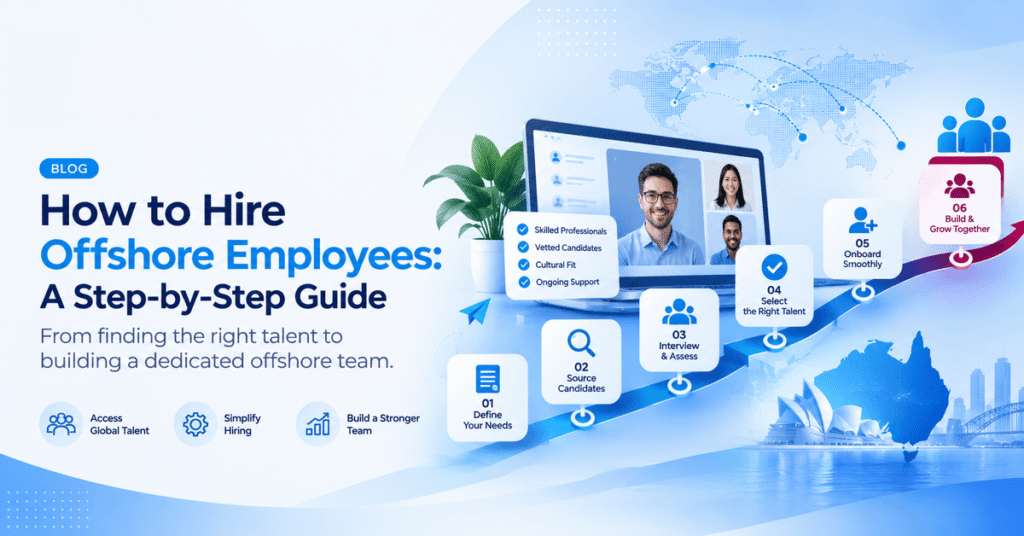
A Practical Process for Building a Dedicated Offshore Team
Successful offshore hiring starts with planning rather than recruitment.
Step 1: Start with the business problem
Before creating a job description, identify what the new role is supposed to solve.
Is a department overloaded?
Has local recruitment become difficult?
Is the business missing a specialist skill?
Are senior staff spending too much time on routine administrative work?
A clearly defined problem usually leads to a better role design.
Step 2: Define the position properly
Document the role in detail.
Include:
- core duties
- technical requirements
- preferred experience
- software knowledge
- reporting lines
- communication expectations
- working hours
- performance expectations
A precise role profile makes candidate matching far easier.
Step 3: Decide where the role sits in the organisation
Work out who will manage the offshore employee and how that person will communicate with the Australian team.
Remote staff should not be left outside normal business processes.
Where appropriate, include them in meetings, training, shared systems and team communication channels.
Step 4: Recruit for more than technical skill
Professional capability matters, but remote work also depends heavily on communication, reliability and the ability to follow structured processes.
The interview process should assess both technical competence and how the candidate is likely to work with the team.
Step 5: Create a structured onboarding experience
A remote employee needs clarity from the beginning.
Provide:
- role responsibilities
- system access
- process documentation
- introductions to relevant colleagues
- communication protocols
- performance expectations
- role-specific training
Step 6: Create predictable communication
Remote collaboration is easier when communication routines are clear.
Depending on the role, that might mean daily updates, weekly meetings, shared dashboards, documented workflows or project-management tools.
Step 7: Measure results clearly
Employees need to know how success will be assessed.
Depending on the role, that may involve:
- accuracy
- quality
- response times
- productivity
- project delivery
- turnaround time
- customer service outcomes
Clear expectations make performance easier to manage for both sides.
Challenges Businesses Should Plan For
Offshore staffing can work well, but it still requires good operational discipline.
Communication differences
Different working and communication styles can create confusion.
Clear instructions, documented procedures and regular discussion can reduce the risk.
Time-zone coordination
Some roles need substantial overlap with Australian working hours, while others can be managed with partial overlap or asynchronous work.
The requirement should be defined before recruitment begins.
Weak internal processes
Offshore staff can expose unclear workflows that already exist inside the business.
Documenting processes before the team expands can make integration smoother.
Data security
Remote employees may need access to internal systems and confidential information.
Businesses should review access controls, cybersecurity requirements, internal procedures and data-handling expectations before access is granted.
Lack of team integration
Offshore staff can struggle if they are treated as a completely separate group.
Better integration usually comes from helping remote employees understand the company, the team’s objectives and how their work connects to broader business outcomes.
Choosing an Offshore Staffing Partner
A provider should offer more value than simply forwarding résumés.
When comparing offshore staffing partners, examine:
Recruitment capability: Can the provider find people with the right experience for your role and industry?
Candidate screening: How are applicants assessed before you meet them?
Transparency: Is the staffing arrangement explained clearly?
Onboarding support: What help is provided after a candidate is selected?
Ongoing support: What assistance remains available after placement?
Communication: Is there a clear point of contact?
Scalability: Can the model support the business if one role later becomes a larger team?
Offshore staffing is usually a longer-term workforce decision, so the provider should be evaluated accordingly.
Why ReCom Australia?
ReCom Australia helps Australian businesses build offshore teams by connecting them with skilled global professionals.
Its role is to support the journey from identifying a workforce need through talent sourcing, recruitment, onboarding and ongoing team support.
ReCom Australia supports businesses across Construction & Engineering, Accounting & Finance, Retail & eCommerce, Manufacturing, Insurance, Healthcare, IT & Software, Energy & Resources, Logistics & Supply Chain, and Marketing & Advertising.
For organisations that want to increase capacity without managing every part of offshore recruitment on their own, a dedicated staffing partner can make the process easier to coordinate.
Frequently Asked Questions
What is offshore staffing?
Offshore staffing allows a business to recruit professionals located overseas who work remotely within its wider team. The model can help companies access additional capability, broaden their talent pool and increase workforce capacity without limiting recruitment to one local market.
Is offshore staffing the same as outsourcing?
No. Outsourcing usually involves transferring a service or process to an external provider. Offshore staffing generally involves recruiting professionals who work more directly within the company’s own operating structure.
What roles can be offshore?
Many digitally delivered roles can be suitable, including accounting support, administration, software development, drafting, estimating support, eCommerce operations, marketing, logistics administration and customer service.
Is offshore staffing suitable for small businesses?
Yes. A business can begin with one offshore professional and expand only when its operational requirements justify a larger team.
How are offshore employees managed?
Good management usually depends on clear responsibilities, documented processes, regular communication, appropriate technology and measurable expectations.
How long does it take to build an offshore team?
The timeframe depends on the complexity of the role, candidate availability, screening requirements and the number of people being recruited. Specialist roles may take longer to fill than more general support positions.
How should I choose an offshore staffing provider?
Consider the provider’s recruitment capability, candidate screening process, transparency, onboarding support, communication, industry understanding and ongoing workforce support.
Conclusion
Offshore staffing gives Australian companies another way to access skilled professionals and increase business capacity beyond geographic boundaries.
The strongest results come from treating offshore employees as part of a workforce strategy rather than as a low-cost substitute for local staff.
Clear role design, careful recruitment, structured onboarding, effective communication and consistent management are what turn offshore hiring into a sustainable operating model.
Looking to build your offshore team? Talk to ReCom Australia about your staffing requirements and the skills your business needs.