
Hiring offshore employees is not simply a matter of finding someone overseas who can complete a task.
A successful offshore workforce starts with deciding which roles make sense remotely, defining expectations clearly, recruiting the right people, onboarding them properly and creating a management structure that supports consistent performance.
When those steps are handled in order, the process becomes much easier to manage.
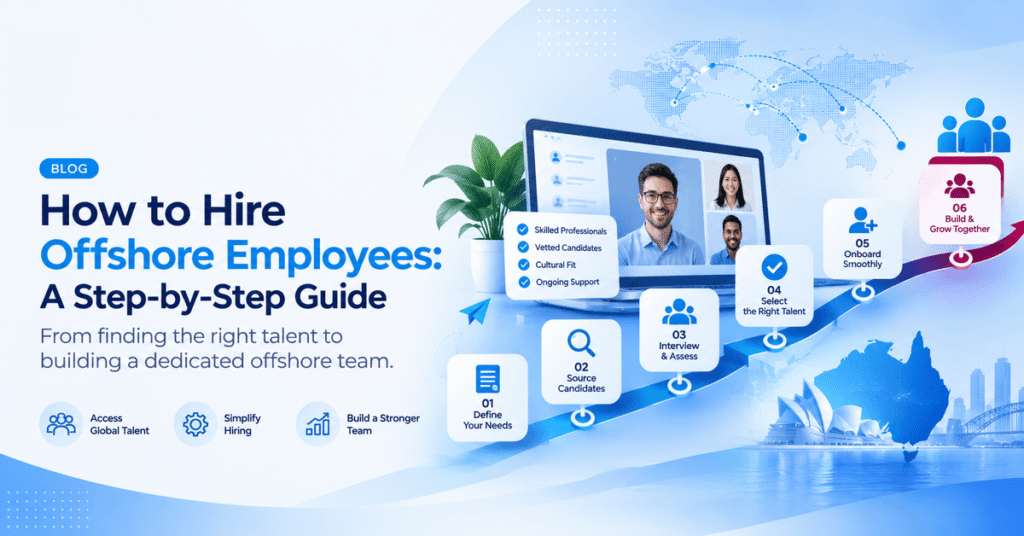
This guide takes Australian businesses through seven practical stages, from identifying the first role through to building and supporting a broader offshore team.
What Does Hiring Offshore Employees Involve?
Hiring offshore employees means adding professionals who are based in another country to your wider workforce.
These employees may work remotely within a department, support recurring business processes and collaborate directly with managers and colleagues in Australia.
This differs from hiring a freelancer for a one-off project.
An offshore employee may attend meetings, use company systems, follow internal workflows and perform an ongoing role within the business.
The goal is therefore to create additional workforce capability, not simply to outsource a task.
Step 1: Decide Which Role Should Be Offshore
Before thinking about recruitment markets, decide what work the business actually needs support with.
Review areas where:
- teams are overloaded
- recruitment has been difficult
- repetitive work is taking specialists away from higher-value tasks
- digital work can be completed remotely
- additional capacity would support growth
- the business requires skills that can be sourced internationally
The fact that a role can be moved offshore does not automatically mean it should be.
Consider whether the work can be defined clearly and managed effectively at a distance.
Useful questions include:
What should this person achieve each week?
Who will manage them?
Which systems will they use?
Does the role require regular face-to-face interaction in Australia?
How much Australian market or business knowledge is essential?
Can success be measured clearly?
Are the relevant processes documented?
These questions help test whether the role is genuinely suitable for offshore staffing.
Step 2: Define the Role, Skills and Responsibilities
Avoid creating a job description that lists every possible requirement without identifying what is actually necessary.
A better approach is to separate expectations into three categories.
Essential skills
These are the abilities the employee needs from day one, such as:
- technical knowledge
- software proficiency
- relevant professional experience
- communication capability
Preferred skills
These are useful but may not be essential for a strong candidate.
Trainable knowledge
This includes company-specific knowledge that can be learned after joining, such as internal workflows, customer processes, reporting formats and proprietary systems.
This distinction makes the role easier to recruit for and prevents unnecessary over-specification.
Build a Clear Job Description
The job description should explain:
- the job title
- the purpose of the position
- main responsibilities
- essential skills
- preferred experience
- software or technology requirements
- reporting lines
- working hours
- communication expectations
- measurable outcomes
Avoid vague statements that do not explain what the employee will actually be expected to do.
A precise brief usually leads to stronger candidate matching.
Step 3: Choose the Right Offshore Staffing Model
Australian businesses can access international talent in different ways.
The right structure depends on whether the requirement is project-based, process-based or part of the ongoing workforce.
Independent freelancers
Freelancers can be useful for defined projects, specialised assignments or flexible short-term needs.
They may be less suitable where the goal is to create a long-term internal role.
Traditional outsourcing
With outsourcing, an external provider usually takes responsibility for delivering a defined service or business process.
The client manages the outcome more than the individual employees.
Dedicated offshore staffing
With a dedicated staffing model, the company builds a team of offshore professionals who work more closely within its existing structure.
The Australian business generally has greater input into recruitment, responsibilities, workflows and day-to-day priorities.
For companies seeking long-term workforce capacity, this model can create stronger integration between offshore and local teams.
Step 4: Source and Screen Candidates Carefully
Once the position is properly defined, recruitment can begin.
The search should focus on a combination of technical competence, relevant experience and communication ability.
Examine actual experience
Do not rely only on job titles.
Candidates with similar titles may have performed very different work.
Look at the responsibilities they handled in practice.
Test technical capability where appropriate
Specialist roles may benefit from a practical assessment.
Any test should relate closely to the actual work rather than focusing on theoretical knowledge that does not matter in the position.
Assess communication
Remote work depends heavily on clear digital communication.
Candidates should be able to:
- explain ideas clearly
- ask useful questions
- understand instructions
- raise problems when necessary
- provide concise updates
Communication ability can be as important as technical skill in a remote role.
Understand working style
Ask candidates how they manage priorities, organise their work and respond when something goes wrong.
The aim is not to find one ideal personality, but to understand whether the person’s way of working fits the organisation.
Step 5: Interview and Select the Right Person
Managers in Australia should ideally take part in final interviews for employees who will work directly within their teams.
A staffing partner can help source and screen candidates, but the business still needs to judge whether the person is the right fit for the role.
Keep interviews structured
Ask shortlisted candidates a consistent set of core questions so their responses can be compared more fairly.
The interview may cover:
- relevant experience
- technical responsibilities
- communication
- problem solving
- time management
- software knowledge
- remote-work experience
- realistic job scenarios
Use practical scenarios
Instead of asking:
“Are you good at handling deadlines?”
Ask:
“You have three tasks due on the same day and cannot complete all of them. What would you do?”
This gives the interviewer more insight into how the candidate thinks.
Do not select purely on price
Compensation matters, but the lowest-cost candidate is not always the strongest hire.
Quality, experience, reliability, communication and long-term suitability should also influence the decision.
Step 6: Onboard the Employee Properly
Recruitment often receives most of the attention, but onboarding is what turns a successful hire into a functioning team member.
Do not assume an experienced professional will immediately understand the way your company operates.
Before the first day
Prepare:
- system access
- company email
- required software
- equipment arrangements
- business information
- process documentation
- training materials
- meeting invitations
During the first week
Introduce the new employee to the people they will work with and explain:
- the company structure
- business objectives
- customers
- team responsibilities
- communication expectations
- escalation procedures
- performance measures
During the first month
Give regular feedback.
Remote employees cannot rely on informal office conversations to absorb information, so expectations often need to be communicated more deliberately.
Frequent early check-ins can identify misunderstandings before they become larger problems.
Step 7: Manage, Support and Expand the Offshore Team
Hiring is only the beginning.
Consistent performance depends on management.
Define expected outcomes
Employees should know how their work will be assessed.
Depending on the role, measures may include:
- quality
- accuracy
- response time
- project completion
- productivity
- customer outcomes
- reporting deadlines
Build communication routines
The aim is not to create unnecessary meetings.
It is to make communication predictable.
That may include:
- daily team check-ins
- weekly one-to-one discussions
- project updates
- monthly performance reviews
Document important knowledge
Written processes reduce reliance on verbal instruction.
Useful resources can include:
- standard operating procedures
- checklists
- process maps
- templates
- training recordings
- knowledge bases
Treat offshore employees as part of the organisation
Where appropriate, include offshore staff in:
- team meetings
- business updates
- training
- planning sessions
- project discussions
That helps remote employees understand how their work connects with wider company objectives.
Common Offshore Hiring Mistakes
Many problems can be prevented before recruitment starts.
Recruiting without a clearly defined role
If responsibilities are vague, it becomes harder to assess candidates properly.
Focusing only on cost
A low-cost hire can become expensive if poor performance creates rework, closer supervision or replacement.
Expecting immediate productivity
Experienced people still need time to learn systems, processes and expectations.
Weak documentation
Remote employees need access to clear information and documented workflows.
Too little management
Offshore employees still require leadership, feedback and direction.
A staffing provider can support workforce administration, but operational management remains important.
Separating offshore and Australian teams
Collaboration can suffer if offshore staff are treated as a disconnected group.
Where practical, build one operating team rather than two separate ones.
Choosing an Offshore Staffing Partner
Businesses that do not want to manage every part of offshore recruitment themselves may choose to work with a staffing provider.
A suitable provider should be able to explain:
- how candidates are sourced
- how screening is handled
- how the business participates in selection
- what onboarding support is available
- what ongoing support is included
- what the staffing arrangement covers
- how communication is managed
- how additional roles can be added later
The provider should also understand the company’s actual requirements rather than simply sending large volumes of résumés.
Candidate fit matters more than résumé quantity.
Why ReCom Australia?
ReCom Australia helps Australian businesses build offshore teams using skilled global professionals.
Support can extend from defining workforce requirements and sourcing candidates through onboarding and ongoing team assistance.
ReCom Australia works across Construction & Engineering, Retail & eCommerce, Accounting & Finance, Manufacturing, Insurance, Healthcare, IT & Software, Energy & Resources, Logistics & Supply Chain, and Marketing & Advertising.
For a business hiring offshore for the first time, having support across the recruitment and workforce process can reduce the complexity involved in establishing one role and later expanding it into a broader team.
Frequently Asked Questions
How do Australian companies hire offshore employees?
The process usually involves defining the role, choosing a staffing model, sourcing candidates, screening and interviewing applicants, selecting the preferred person, onboarding them and putting ongoing management processes in place.
What jobs can be done offshore?
Many digitally delivered positions may be suitable, including accounting support, administration, software development, customer support, marketing, eCommerce operations, estimating support, drafting and logistics administration.
Should I hire directly or use an offshore staffing provider?
That depends on the business’s internal recruitment capability, overseas employment knowledge and desired level of support. A staffing provider can assist with recruitment, sourcing, onboarding and ongoing workforce administration.
How should I interview offshore candidates?
Use structured interviews that examine relevant experience, technical capability, communication skills and practical workplace scenarios. Managers who will work directly with the employee should participate in final selection.
How should an offshore employee be onboarded?
Provide clear role expectations, system access, documentation, training, introductions and regular manager contact. Remote employees usually benefit from particularly clear communication during their first several weeks.
How are offshore employees managed effectively?
Clear responsibilities, documented processes, collaboration tools, regular communication and measurable performance expectations are central to effective remote team management.
Can a company begin with just one offshore employee?
Yes. A business can start with one clearly defined role and expand later once it has developed effective recruitment, onboarding and management processes.
What should I look for in an offshore staffing partner?
Look for transparent recruitment methods, candidate screening, onboarding support, ongoing workforce assistance, clear communication and a strong understanding of the business requirement.
Conclusion
Offshore hiring can give Australian companies access to a broader talent pool and create additional workforce capacity.
But successful hiring depends on more than candidate availability.
Businesses need to select the right role, define it carefully, recruit deliberately, onboard well and manage offshore employees as part of the wider organisation.
A practical starting point is one clearly defined business need. The team can grow from there.
Looking for skilled offshore professionals? Talk to ReCom Australia about the roles, capabilities and workforce support your business needs.