
For Australian businesses exploring offshore staffing, price is usually one of the first practical questions.
There is no single figure that applies to every role.
The cost of hiring an offshore accountant, developer, estimator, customer service professional or marketing specialist can differ significantly depending on experience, skill level, location, employment structure and the services included by the staffing provider.
That is why a useful comparison should focus on the total workforce cost rather than on an advertised salary alone.
This article explains the main cost drivers, what may be included in an offshore staffing arrangement and how Australian companies can compare options more accurately.
What Does Offshore Staffing Cost?
Offshore staffing pricing is usually shaped by the type of role being recruited, the employee’s level of experience, the talent market and the support built into the arrangement.
A general administrative position will naturally have a different cost profile from a senior software engineer, experienced accountant or specialised technical professional.
The total may also depend on whether the arrangement includes:
- talent sourcing
- recruitment
- candidate screening
- onboarding
- workforce administration
- payroll support
- HR support
- equipment or workspace
- ongoing account support
Two providers may therefore quote different amounts while offering substantially different levels of service.
The Main Factors That Influence Cost
1. The role itself
Every profession has a different labour market.
Broad administrative roles may have a larger candidate pool, while specialised engineering, finance or technology positions can require more targeted recruitment.
2. Required experience
Junior, intermediate and senior professionals will generally have different compensation expectations.
Businesses should be realistic about the level they need.
Specifying more experience than the work requires can increase costs unnecessarily, while choosing too little experience may create capability problems.
3. Specialist skills
Some jobs require expertise in particular software, systems or technical disciplines.
Examples may include:
- accounting platforms
- CAD or engineering applications
- programming languages
- eCommerce systems
- enterprise software
- specialist design tools
The more specific the combination of requirements, the narrower the candidate pool may become.
4. Location of the talent
Employment costs vary between offshore markets.
Businesses should not assume that all offshore locations provide the same combination of price, skills and workforce conditions.
Cost needs to be considered alongside:
- talent quality
- communication
- experience
- working-hour availability
- workforce stability
- infrastructure
5. Working-hour expectations
Some companies need their offshore employees to work with substantial overlap into Australian business hours.
Others can operate effectively with partial overlap or asynchronous workflows.
These expectations should be clear from the beginning.
6. Complexity of recruitment
A common support role can be easier to source than a specialist position requiring technical expertise, industry knowledge and strong communication skills.
That difference may affect the recruitment effort required.
7. Level of provider support
Not all offshore staffing providers use the same service model.
One may focus mainly on candidate sourcing, while another may also include onboarding, workforce administration and ongoing support.
Price should therefore be interpreted in the context of the service being offered.
What May Be Included in an Offshore Staffing Arrangement?
Before comparing quotations, businesses should ask what is actually covered.
Employee compensation
This reflects the cost associated with employing the offshore professional.
The appropriate level depends on the role, experience and relevant labour market.
Recruitment and sourcing
Candidate search, advertising, screening and recruitment coordination all form part of the hiring process.
Businesses should confirm whether these activities are included or charged separately.
Candidate assessment
Screening may involve résumé review, preliminary interviews, skills testing and role-specific evaluation.
Ask how far a candidate has been assessed before being introduced to your business.
Onboarding
Once an employee is selected, the setup process still needs to be managed.
That can include documentation, system access, workforce setup and operational preparation.
Workforce administration
Some staffing arrangements include administrative support connected to the employment relationship.
The business should understand which responsibilities are handled by the provider and which remain internal.
Ongoing support
The relationship may continue well beyond the employee’s start date.
Depending on the provider, ongoing assistance may include workforce coordination, communication support and operational help.
Comparing Offshore Staffing With Local Hiring
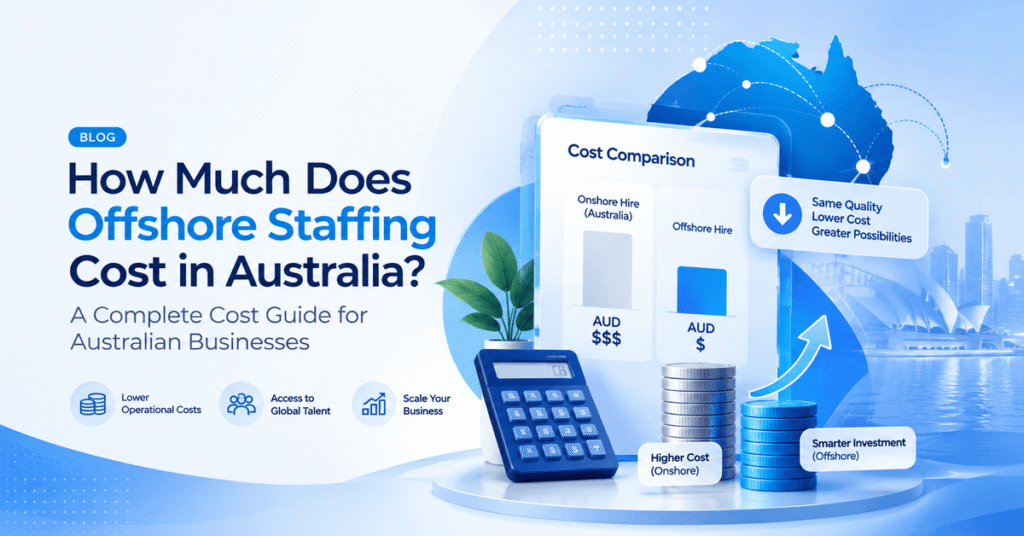
A useful cost comparison goes beyond salary.
Local hiring may include several workforce-related expenses and internal costs in addition to base pay. Offshore staffing can also involve more than the employee’s direct compensation.
The comparison should therefore consider the total cost of establishing and supporting the role under each model.
Questions worth asking include:
- What recruitment costs will be incurred?
- How much internal management time will hiring require?
- Will office space be needed?
- What software and equipment will the employee require?
- What administrative work is involved?
- How difficult is the position to recruit locally?
- How quickly does the business need extra capacity?
- What support is included in the offshore model?
This creates a more meaningful comparison than putting two salary figures next to each other.
Is Offshore Staffing Automatically the Cheaper Option?
Cost efficiency is one reason businesses consider offshore staffing, but selecting the lowest-priced candidate or provider is not necessarily a strong workforce decision.
An employee who requires significant rework, close supervision or replacement can become poor value even if the initial cost is low.
Likewise, a very low provider quote may exclude services that are included elsewhere.
So the more useful question is not:
Which option has the lowest price?
It is:
Which option gives our business the capability, quality, capacity and support we require at a sustainable total cost?
Costs That Are Easy to Miss
A realistic offshore budget should account for more than the employee rate.
Management time
Remote employees still need leadership, feedback, training and direction.
Technology
Offshore team members may require access to:
- communication software
- project-management platforms
- cloud applications
- specialist systems
- secure internal tools
Those costs belong in the overall workforce budget.
Equipment
Depending on the arrangement, computers, monitors, headsets or specialist equipment may be required.
Confirm whether these are supplied by the provider or paid for separately.
Training
Even highly experienced employees need time to learn company processes, systems, customers and expectations.
Process documentation
If the business relies on undocumented knowledge, managers may need to create standard operating procedures before the offshore employee can work effectively.
That effort can also improve the business more broadly.
Replacement and recruitment risk
Turnover can lead to additional hiring and training costs.
Businesses should understand how a provider handles situations where an employee leaves or is not suitable for the role.
Building a More Accurate Offshore Staffing Budget
Step 1: Define the role
Describe the actual work required and separate essential capabilities from preferences.
Step 2: Choose the appropriate experience level
Decide whether the role genuinely requires a junior, intermediate or senior professional.
Step 3: Set working-hour expectations
Clarify the degree of overlap required with the Australian team.
Step 4: Map technology needs
List required software, equipment and system access.
Step 5: Understand the provider’s inclusions
Ask what services are built into the quoted price.
Step 6: Include internal management effort
Identify who will train, supervise and support the offshore employee.
Step 7: Compare total cost on the same basis
Make sure each provider is being assessed against the same assumptions.
An all-inclusive staffing model should not be compared directly with a salary-only figure.
Looking Beyond Price: Measuring Business Value
The value of an offshore role should be linked to what it enables the business to achieve.
Consider whether the position can:
- increase workforce capacity
- shorten turnaround times
- reduce pressure on existing staff
- support more customers
- strengthen operational processes
- free senior employees for higher-value work
- help the business expand a function
For example, the value of an offshore finance professional is not limited to staffing cost.
If that person increases processing capacity and gives an Australian finance manager more time for planning, analysis and stakeholder responsibilities, that operational effect matters as well.
Comparing Offshore Staffing Providers
To compare pricing properly, give each provider the same role brief.
Then evaluate:
Role suitability: Do the proposed candidates match the business need?
Pricing transparency: Is it clear what the quoted amount includes?
Recruitment: How are candidates found and assessed?
Onboarding: What support is provided before the employee begins?
Ongoing support: What help is available after placement?
Communication: Who will handle questions and account support?
Scalability: Can the model expand if the business later needs a larger team?
The lowest-cost proposal and the strongest workforce solution may not be the same.
Why ReCom Australia?
ReCom Australia helps Australian businesses access skilled global professionals and build dedicated offshore teams.
Its support covers talent sourcing and recruitment as well as onboarding and ongoing team support.
This allows businesses to evaluate offshore staffing as a broader workforce solution rather than treating recruitment as a one-off transaction.
Whether the goal is to hire one offshore professional or build a larger team, defining the role properly is the first step towards understanding likely cost.
Frequently Asked Questions
How much does offshore staffing cost in Australia?
There is no universal price. Cost depends on the position, experience level, technical skills, offshore location, working hours and the services included by the staffing provider.
Is offshore staffing cheaper than local hiring?
It can provide a more cost-effective way to access certain skills and expand capacity, but the comparison should be based on the full cost of the role rather than salary alone.
What should an offshore staffing quote include?
A clear quote should explain employee-related costs and any charges for recruitment, onboarding, equipment, workforce administration or ongoing support.
Are there setup costs?
That depends on the provider and the staffing model. Recruitment, onboarding, equipment and administration may be included or charged separately.
Why can offshore staffing quotes vary so widely?
Providers may use different talent markets, target different experience levels and include different services. Two quotations may therefore represent very different solutions.
Should a business choose the lowest-cost provider?
Price matters, but it should be considered alongside candidate quality, transparency, recruitment process, support and workforce stability.
Can a business start with one offshore employee?
Yes. A company can begin with a single position and expand later as its needs increase.
Conclusion
Offshore staffing costs depend on more than the country where the employee is based.
Role complexity, experience, technical capability, recruitment support, onboarding and ongoing workforce services all influence the overall investment.
Australian businesses will get a clearer picture by defining the position first and then comparing providers on equivalent terms.
That approach makes it easier to assess not just what an offshore employee costs, but what capability and capacity the role can add to the business.
Want to understand what an offshore role could look like for your business? Discuss your staffing requirements with ReCom Australia.